Green foam, soapy suds, Jell-O, live carp and bikini tops have all made their way into the history of one of IU’s most beloved landmarks.
Since it was installed nearly 50 years ago, the Showalter Fountain has been a witness to IU history. It has been vandalized in moments of frustration and victory while also serving as a place for students to congregate – at times united in grief.
For a quarter-century, it was legendary IU President Herman B Wells’ pet project, but the fountain never escaped the controversy of Venus’ naked form.
After more than 25 years of planning, the Showalter Fountain was dedicated in 1961 by Grace Showalter to honor the passing of her husband, Ralph, a longtime trustee of the University.
The fountain was conceived as the centerpiece of the Fine Arts Plaza, which includes the IU Auditorium, the School of Fine Arts and the Lilly Library.
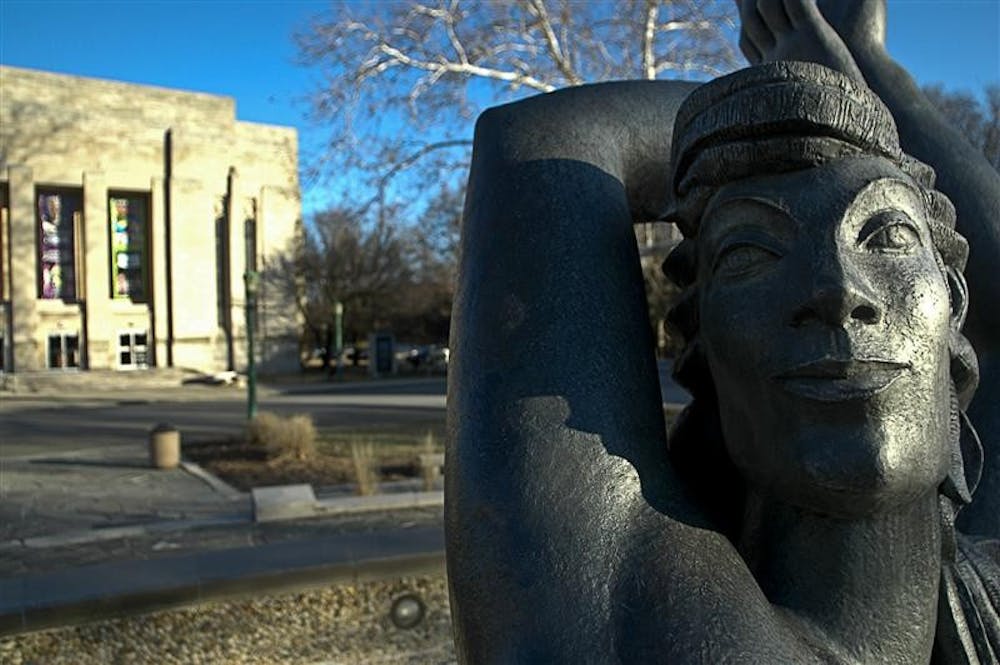
The Showalter Fountain depicts the birth of Aphrodite – the Greek goddess of love and beauty – from the sea, said Department of Classics professor Margaretha Kramer-Hajos.
The fountains in Rome and Botticelli’s famous painting “The Birth of Venus” inspired sculptor Robert Laurent, an IU professor of fine arts, to design the fountain, with Venus as its 14-foot-long centerpiece.
A photo of Laurent working on the statue appears in the 1959 Arbutus yearbook.
“Some people think she’s too big or that she doesn’t fit in her shell,” the artist told the Indiana Daily Student in 1974. But for Wells, the project represented IU’s commitment to the arts. The fountain is a “great place for students to rendezvous and tryst,” Wells later said.
Victories, protests, gatherings... pranks?
Besides acting as a meeting place for students during the warm weather months, the Showalter Fountain has also become a site for many special IU events.
Dean of Students Dick McKaig said the fountain serves as a natural gathering place for students because of its location and scale.
He recalled student vigils at the fountain, including Middle Way House’s Take Back the Night, an annual march and rally against sexual and domestic violence.
After IU’s 1976 and 1987 NCAA basketball championship wins, students gathered at Showalter Fountain to celebrate. In 1987, the mob broke some of the stone dolphins in celebration and hauled them away.
Only one missing dolphin resurfaced, wearing red lipstick and an IU T-shirt. The others were later replaced at the University’s expense.
McKaig also recalled students gathering in protest at the fountain after former IU basketball coach Bob Knight was fired, and in times of tragedy, the fountain served as a place for students to unite in grief.
On the evening of Sept. 11, 2001, for example, the IU community held a memorial service at the fountain.
“The whole plaza was filled with people, shoulder to shoulder,” McKaig said.
Legends
For a campus landmark, the fountain is steeped in myth.
Venus’ breasts were made smaller after Showalter’s wife objected to their size, according to a 1974 IDS article.
And if an IU woman is still a virgin at graduation, the dolphin between Venus’ legs will purportedly swim around the fountain, according to a Web site created by the Folklore and Ethnomusicology Department, hoping to preserve IU’s legends.
McKaig said the Showalter Fountain continues to be an integral part of the IU campus not just because of its sense of mystery, but because it is a part of campus history.
“It is iconic,” McKaig said, “because of the nature of the surroundings, its centrality to campus and its sheer beauty as a space on the University property.”
A witness to IU history
Get stories like this in your inbox
Subscribe