
It doesn’t matter who is running for president, as long as they fit party ideas, said Gary Jacobson, University of California political science professor during a speech Wednesday evening.
Jacobson spoke to more than 40 audience members in a lecture called “The Bush Legacy and the 2008 Elections” in Woodburn Hall. The lecture was the third and last in the series presented by the IU Institute for Advanced Study and the IU Center on Congress.
Jacobson has been a professor for about 29 years, and his research revolves around partisanship and polarization in elections, on which he has written many books and articles. In this lecture, he focused on themes mentioned in his newest book, “A Divider, Not a Uniter: George W. Bush and the American People.”
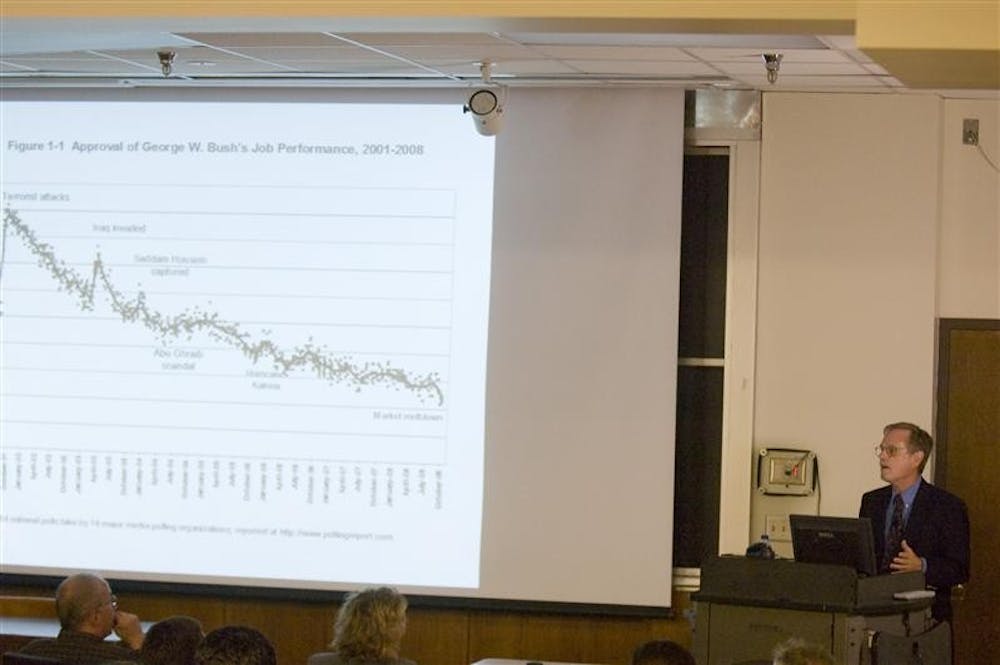
In his speech, Jacobson used a series of line graphs that showed the correlation between Bush’s presidency and his popularity among Republicans and Democrats.
The first graph he presented showed a downward slope of Bush’s job approval ratings from 2000 to 2008, which was at its highest after the terrorist attacks on Sept. 11. His approval ratings went down after the invasion of Iraq, the Abu Ghraib scandal, Hurricane Katrina and the recent economic crisis.
The other line graphs Jacobson showed pictured red and blue lines that represented Republicans and Democrats who approved of Bush’s administration. At the very end of almost every graph, there was a huge margin between the red and blue lines, showing the partisanship within the population which was polled.
Jacobson said Bush took over an already politically polarized country, but Bush only focused on his own Republican ideals, which Jacobson said caused the strong partisanship in the country today.
“The Republicans are saying, ‘Look, we won. We have a Republican agenda. We will follow that agenda,’” he said. “He is the most divisive and polarizing president we have ever had.”
Although Bush’s approval rating is now close to 20 percent, Republicans are continuing to stay within the party, Jacobson said. Therefore, Democrats are not necessarily gaining from Bush’s unpopularity.
However, he said, Democrats can gain from new, young voters who will walk into voting booths for the first time on Nov. 4. Jacobson said this is because younger voters are usually liberal on social issues such as gay marriage and immigration.
Jacobson said that in this election, presidential nominee John McCain hopes to improve the portrayal of the Republican Party. However, he said he doesn’t believe McCain has differentiated himself from Bush enough to change the party’s image, saying the McCain campaign wants voters to forget the Bush administration, not acknowledge it.
Jacobson said Democratic nominee Barack Obama might have a disadvantage because he identifies himself as black. He said he plans to look for a racial element at the end of the presidential race, but Obama might have already had a larger lead on McCain if he were Caucasian.
“Obama has an 8- to 9-percent lead (on McCain) on average,” Jacobson said. “But it would be a 15-point lead if he were white.”
Despite criticisms on McCain and Obama, Jacobson said voters will still vote for their own party.
“Eighty percent of voters already made up their minds on who to vote for in January, between the ‘D’ and the ‘R,’” he said. “Voters don’t care who’s carrying the issues.”
Author: Party affiliation, not candidate, has biggest effect on elections
Professor speaks on partisanship, Bush legacy
Get stories like this in your inbox
Subscribe



