Holy smokes, Batman!
Until recently, phrases like this were what would come to mind when someone mentioned Batman. Only in the last 20 years has the character begun to be taken seriously once again, thanks in part to Tim Burton’s and more recently, Chrisopher Nolan’s, silver-screen adaptations.
Batman started out in 1939 as a dark detective, created by Bob Kane for National Comics, which later became DC Comics. Drawing inspiration from Zorro, Sherlock Holmes and the Shadow, Batman was envisioned as a gothic protector of a city gone wrong, a grim and gritty vigilante with a strict moral code, avenging the deaths of his parents.
Early on, in the 1940s, the Batman universe was subtly altered with the introduction of Robin. Tempering Batman’s harsh demeanor, he was to be the Watson to Batman’s Holmes, someone in which the caped crusader could confide. But in the ’50s, with diminishing sales and a cultural outcry against the perceived moral menace that comics posed, a new Batman was born.
This Batman, known as the “Silver Age” incarnation of the character, was much lighter and campier than the previous portrayals of the vigilante. With Julius Schwartz writing, Batman became a more happy-go-lucky crime fighter in a comic filled with gimmicks such as Ace the Bat-Hound and female characters like Batgirl to downplay the perceived homosexuality of Batman and Robin.
This led to the often praised and much lamented Batman show that ran from 1966 to 1968 starring Adam West and Burt Ward.
Though popular, the show soon wore thin and was cancelled after three seasons and 120 episodes. Sales of the comic book were still down, and it was time to take a new direction. In 1969, Dennis O’Neil and Neal Adams strived to take Batman back to his dark past and rid the character of the bad taste the TV show had left in the mouth of the public.
Despite these efforts, sales of the book continued to drop until hitting an all-time low in 1985. Things were dark indeed for the world’s greatest detective, until Frank Miller (creator of comics-turned movies “300” and “Sin City”) released his limited series “Batman: The Dark Knight Returns” in 1986.
This tale was of a Batman in his ’50s, a dark, depressed and slightly demented figure that is still considered to be one of the most influential works in the character’s history. The series was a critical and financial success, ushering in a new form of gritty realism for Batman.
It was this book that launched a new era for Batman, followed up by Miller’s acclaimed story line “Batman: Year One,” which retold the character’s origin, allowing for stories without the perceived hindrance of “Robin the Boy Hostage.” This was followed shortly by what is perhaps the second-most important Batman story, Alan Moore’s “The Killing Joke.”
Moore, the genius behind such comics as “V for Vendetta,” “The League of Extraordinary Gentleman” and “Watchmen,” gave us the first concrete origin story of Batman’s greatest villain, the Joker. What “The Dark Knight Returns” did for Batman, “The Killing Joke” did for the clown prince of crime.
For years he had been seen as a wisecracking, prank-pulling nuisance, before Moore showed the Joker as the psychopathic murderer he was always intended to embody. This book showed him crippling Batgirl and kidnapping Commissioner Gordon in an attempt to prove that “all it takes is one bad day to reduce the sanest man alive to lunacy. That’s how far the world is from where I am. Just one bad day.”
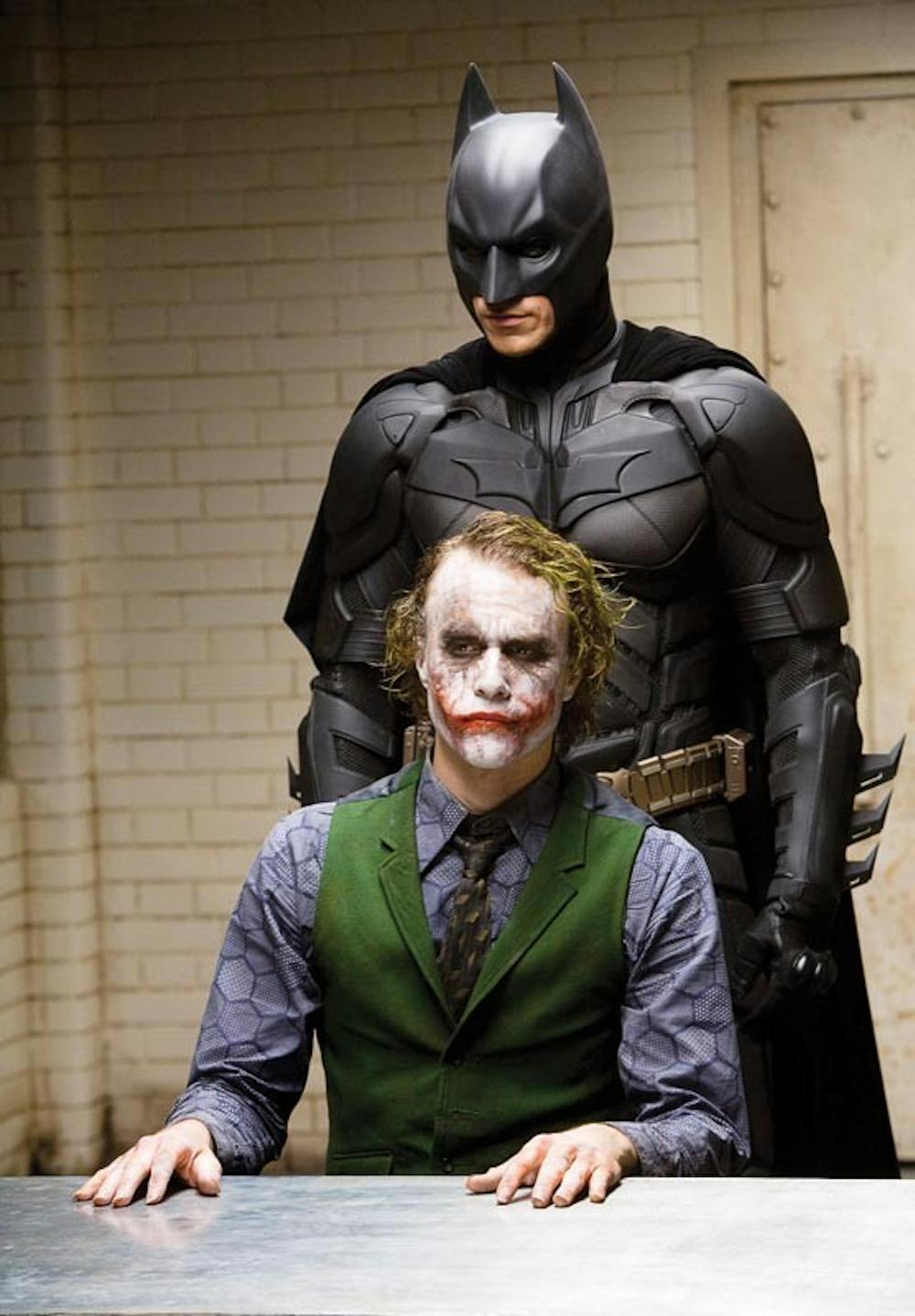
This take on the villain has heavily influenced Nolan’s current film and the late Heath Ledger’s portrayal of him.
Following these groundbreaking stories, producer Michael Uslan and director Tim Burton released “Batman” in 1989, a movie that set box-office records and re-introduced the general public to the idea of a scary Batman, one without BIFF! and Pow! Starring Michael Keaton and Jack Nicholson as Batman and the Joker, respectively, the film astounded audiences and critics worldwide, and still endures as one of the greatest comic films to date.
After the success of “Batman,” Warner Bros. followed up with “Batman Returns” in 1992, another dark tale from the twisted direction of Burton.
The 1992 film also saw the debut of the critically renowned “Batman: The Animated Series,” whose portrayals of Batman and the Joker, voiced by Kevin Conroy and “Star Wars”’ Mark Hamill, have become the quintessential versions of those characters in the minds of many fansThe darkness of Batman was quickly tempered, however. In a movement mirroring that of the comics of the ’60s, “Batman Forever” regressed the character to a lighter, campier version aimed at selling toys to kids. Released in 1995 and directed by Joel Schumacher, the film was unpopular, followed by an even worse movie, “Batman and Robin,” in 1997. Filled with puns, gadgets and bad acting, the films effectively killed the Batman franchise.
That is, until 2005.
This marked Christopher Nolan’s landmark film “Batman Begins,” retelling Batman’s origins and returning him to the darkness and grit of the earlier films, just as Neil, Adams, Miller and Moore had done with the comics. Starring Christian Bale, Michael Caine, and Morgan Freeman, “Batman Begins” was met with mediocre box-office and critical reviews, but got a heartfelt approval from comic fans and moviegoers alike.
Now, in 2008, we see the trend continue, with Nolan resurrecting the Joker as an anarchistic psychopath intent on sheer destruction.
Ledger’s performance is already being hailed as Oscar-worthy, and early reviews land the film as being the next legendary crime drama, on par with films like “Chinatown” and the “Untouchables.” For the July 18 release date, theaters sold out of midnight showings and added 3 a.m. and 6 a.m. screenings to meet the demands of rabid fans.
Having come full-circle from darkness to camp and back to darkness, will this new film equal the creative and financial success of its comic counterpart, “The Killing Joke?” This movie could be the definitive Batman film, finally bringing the original vision of the character’s and their world to the screen like never before. High hopes being tempered by Ledger’s death, the movie seems to rest entirely on his performance. Was this role, which may have sparked the insomnia that led to his death, his greatest work? You’ll have to see it to find out.
‘The Dark Knight’ returns Batman to dark, gritty origins
Get stories like this in your inbox
Subscribe