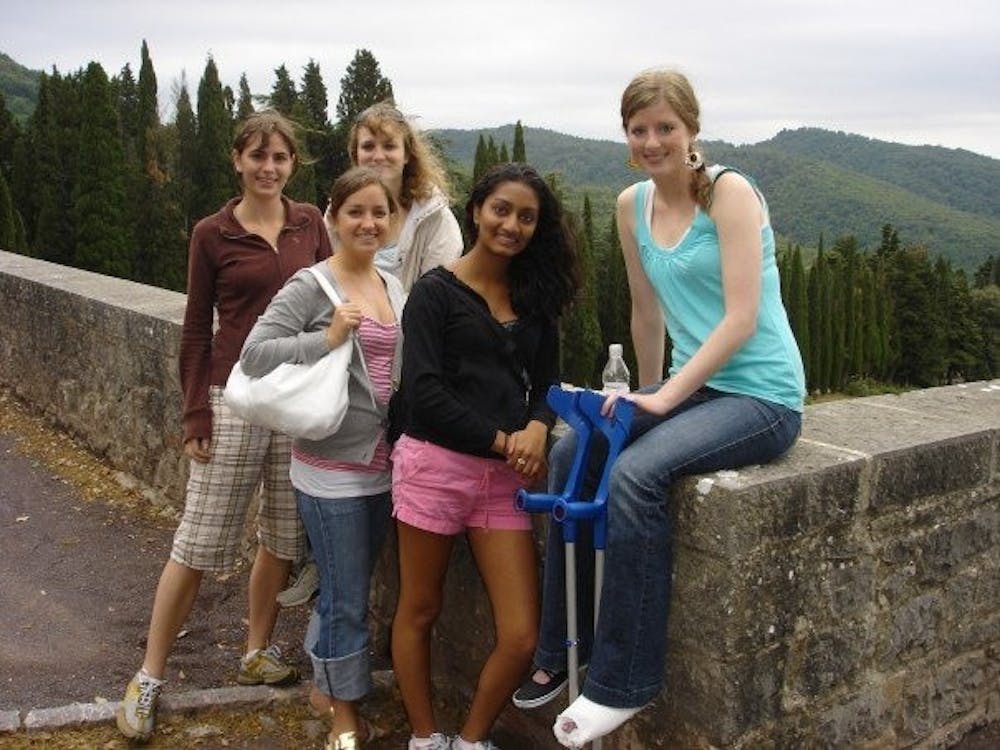
Dressing gowns made by Versace, Murano glass chandeliers and frescoes dating back to the Renaissance: this is what I initially imagined when picturing an Italian hospital in Florence. Instead, I am sitting in an overcrowded, humid room with a dusty floor and cracked walls ... and my foot is killing me.
The night before, I had gone out to a club with a group of friends when, during a brief lapse in judgment, I decided to take an awkward dance step off of a cough table cough. This resulted in immediate pain in the side of my left foot, a piggyback ride home from an IU football player and a trip to the emergency room the next morning.
After being told that I would have to spend my remaining weeks in Italy wearing a plaster cast, I thought that my dreams for an unforgettable European adventure had been shattered.
Because I could no longer travel easily, I thought I was going to be trapped in my room for the rest of the overseas program.
However, contrary to my fears, the Italy that I experienced after my “accident” has completely changed my perspective on Euro-travel, and the art of being an American tourist.
Luckily, during the first few weeks of the program, I behaved as a typical tourist by running to see all of the sights and traveling to different cities in order to absorb as much of Italy as possible. My digital camera always in hand and my eyes constantly glancing from a map to some grand historic structure; my memories of those first few weeks are recalled like snapshots of a country that still seems foreign to me.
But, when handicapped with crutches and a useless left leg, I found that I was spending much less time as a tourist, and more time becoming part of a community.
Since I was no longer able to make it through late-night partying schedules or take long train rides to distant cities, I stayed in Florence and created a daily routine that immersed me into the surrounding neighborhood.
My memories from that time are of sitting with friends in cafes in the Piazza del Duomo, staying up late listening to French electronic music on a broken laptop and drinking wine with a middle-aged Italian man who told stories of riding on a train without a passport into East Berlin during the ’70s.
I also remember talking to other foreigners, such as a young Kurdish man who immigrated with his family to Italy and now works in a kebab shop; and a Japanese man who worked next door to my dorm and had just as much trouble speaking Italian as I did.
As cliche as it sounds, I remember most fondly the people that I met in Italy, and the lives that I became a part of. By connecting with Florence not through how many Michelangelo paintings or Medici monuments I could see, but by exploring the vast number of human lives around me, I was able to forget about my impermanence as a tourist and begin living as a true Florentine.
A year later, when I returned to Italy with my family for a weeklong tour of Rome, Florence and Venice, I found that it wasn’t the monuments or paintings, chapels or museums that I was looking forward to sharing with my family, but the culture, the people and the neighborhood that I became a part of during my stay.
Although it is important to appreciate Italy for its art and history, it is also important, if not more, to appreciate its actual community and the Italian people.
By letting go of my goal to be a super-tourist and see as much of Italy as possible, I began to feel more at home in a city that I thought I could never really be a part of. And, when I finally returned to Florence a year later, it felt like I never left.
Something to write home about
A Hoosier in Italy
Get stories like this in your inbox
Subscribe