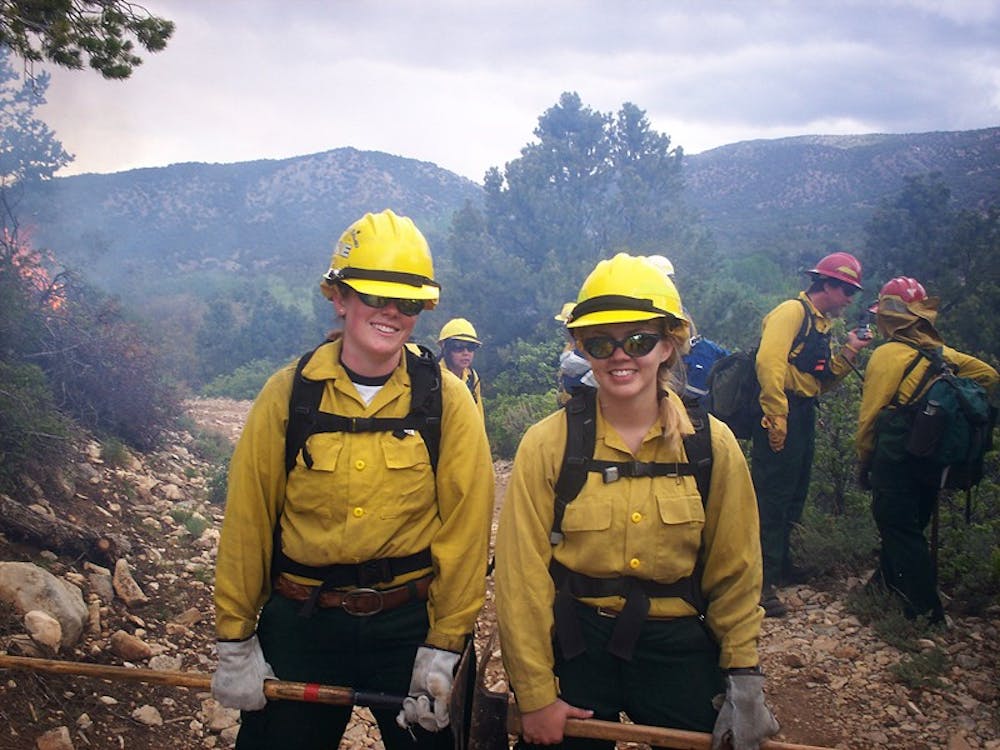
If a year ago you would have told me that I would have a summer job as a firefighter, I would have never believed it. My parents and the rest of my extended family still to this day do not believe it. I had been seriously considering the job for a while, but I had “seriously considered” plenty of outlandish things. Firefighting falls into the category of things I would love to do, but I seemed to lack the skills to put the plan into action.
My whole life I have struggled to be competitive in areas that are generally dominated by men. In fourth grade, when my class was asked which of us would like to join the army, I eagerly raised my hand. A boy scoffed at me, saying that I would never join the army. This made me so mad that I promised him I’d join.
Today, the odds of me enlisting are slim, but I still crave the discipline of the military life. When a Canadian friend of mine told me of his new summer job as a wildland firefighter, I was immediately interested. He told me stories and showed me pictures, all of which mesmerized me — both the pyro and wilderness lover.
A year later, on an IU Outdoor Adventures spring-break trip to Utah, I met a fellow fire lover, my guide Kevin. His enthusiasm nearly sealed the deal. It took almost another year for me to make the decision to actually apply for positions in the Forest Service.
I researched the job extensively before I applied, and I found that wildland firefighting is very competitive. I applied in several states and I got two callbacks. The first call was from the Manti-La Sal National Forest engine crew in Monticello, Utah, and I took the job right away. After going to Utah for spring break, I knew I loved the gorgeous landscape of Arches National Park. Working in a place you love is always a plus.
I drove out to Utah May 11, not quite sure what to expect. I knew this job was going to be demanding, but other than that, I was clueless. I was put in a government bunkhouse with three roommates. Two girls were on a fire crew like me and the third was a student archaeologist. Monticello is rich with artifacts. Wildland fire often uncovers archaeology sites that need to be documented.
After a month of living here, I have learned a lot of things. First of all, going from an Indiana elevation of 500 feet to an elevation of 7,500 is a wake-up call to the lungs, that is for sure. I knew my athletic asthma was going to be a challenge, but I never expected to be winded just by walking up a few stairs because of an elevation change. After a month of 1 1/2-hour early-morning training, I am finally getting used to it. The physical training usually consists of running, and it is recommended that you come to wildland firefighting in top shape. I, however, was not. Each day is a struggle against asthma, elevation, shin splints and a cardiovascular endurance that pales in comparison to any normal firefighting.
The training is rigorous because the demands of firefighting are very arduous. Each firefighter must complete a physical-work capacity test, which consists of a 45-minute three-mile walk with a 45-pound pack. It sounds easy, but don’t fool yourself. I thought it would be easy, too. At a fire, you carry a pack of about 45 pounds wherever you go, while you are swinging ground-grubbing tools like a pulaski.
If you are wondering what a wildland firefighter does, I have one word for you: dig. The job of a wildland firefighter is to dig a fire line around the fire to stop its spread. My job is also to work on an engine, so I work with water as a means of stopping the fire.
The fire season has not started yet, so I have been busy learning in fire school. I am now certified to drive a government vehicle and wield a chainsaw. I have learned about fire behavior, pump operations, safety, hazmat and other valuable skills, all while being paid.
If you are looking for an unconventional, challenging and rather lucrative summer job, wildland firefighting might just be for you.
Something to write home about
A Hoosier with the force
Get stories like this in your inbox
Subscribe