Badd Mudda Trucker. Hell No Kitty. Sagitterrorist. Unicoroner. Rip’r Snap’r. These are the names of members from the Farm Fatales, one of two main teams in Bloomington’s cutthroat roller-derby league the Bleeding Heartland Rollergirls. The Farm Fatales will face off against the other team, the Slaughter Scouts, on May 17 in front of 700 screaming fans at the Bloomington SportsPlex, located at 1700 W. Bloomfield Road, in what has been dubbed a “sibling rivalry” match.
The women of the Farm Fatales are as unique as the building they practice in. Formerly an elementary school, Eagles Landing was converted into a mall in 2003, but little changed except its occupants. The classrooms became shops, but the same distinctly school-tiled floors and painted cement walls still formed the narrow hallways. The gymnasium remained, and ancient-looking pictures of athletic teams of old still hung on the walls.
So it’s fitting that one of Bloomington’s best-kept secrets practices here, hidden away in Ellettsville. But it won’t be a secret for much longer. The league’s original team, the Flatliners, was forced to split into two after the addition of about 20 women at December tryouts. The Flatliners still remain an “all-star” squad, made up of women from both teams.
Roller derby is an American sport that started out involving both male and female team members. It originated in the 1930s and gained popularity all the way through the ’50s, but almost completely died out during the ’70s. Its recent revival has seen the rise of all-female leagues, and the sport’s popularity continues to grow.
At practice, the women’s outfits are anything but uniform. Aside from matching team shirts, the dress code gets creative. Leopard-print tights, striped knee-high socks and sequined belts accent booty shorts and miniskirts. Flames and pirate patches are particularly popular. The women are padded more heavily than a professional skateboarder and, after watching them practice, it’s easy to see why.
“It’s scary when you get injured or get hit in the face. It’s time-consuming and frustrating,” Bloomington roller girl Sagitterrorist said. “You have bad days, but overall it’s pretty addicting.”
Although her name may sound intimidating, Sagitterrorist is a friendly, soft-spoken woman who doubles as an occupational therapist during the day. Like the rest of the roller girls, she only goes by her derby name for public appearances. She tried out for the team in December, so she has yet to make her debut on the track.
Before moving to Bloomington, Sagitterrorist lived in Portland, Ore., where she said roller derby is huge. Between that and watching the A&E reality series “Rollergirls,” Sagitterrorist fell in love.
“I would say roller derby is kind of like having a family full of 38 crazy girls. I think it’s been interesting for us, for veterans and rookies alike. We practiced together for so long, and in March we split. There have been some growing pains, but I think it’s going to be good for us and the Bloomington league as a whole,” Sagitterrorist said. “Lots of other towns have trouble finding enough girls for one team and we have been fortunate enough to find enough to have two.”
The main objective of the roller derby is to score points by passing members of the opposing team on the track. The one scoring the points, the jammer, is blocked out by the rest of the pack. The pivots are the lead blockers who set the pace of the pack, and the wingmen are the ones up front helping the pivots out. Sagitterrorist usually plays pivot or wingman.
As far as injuries go, Sagitterrorist has escaped anything truly damaging. She said she has “luckily” only injured her shoulder and pulled a groin muscle. But just in case, she superstitiously knocks on the gym’s wooden bleachers. A couple teammates knock too, for good measure.
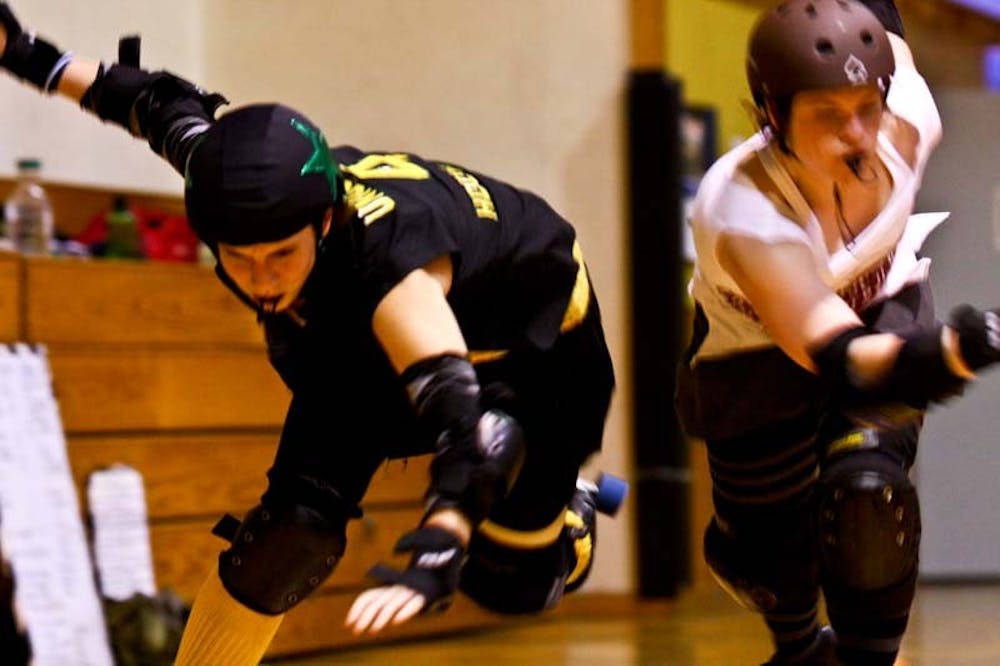
The team doesn’t take injuries lightly. The bouts can get so brutal that the skaters even practice falling correctly to minimize the chances of physical harm. After warming up and practicing weaving maneuvers, the women line up and run suicides, throwing themselves on the floor every few feet. They’re called six-point falls; the aim is to land on the six padded points of impact: knees, elbows and wrists.
And the practice comes in handy. During the last half-hour, the team splits up to scrimmage. They alternate positions, placing alternating jammers. A couple of the guys from the men’s league who practice with them act as referees. They line up, but with the opening bout a week and a half away, the team can’t afford to lose any players, so they’re not going full force.
“This is going to be a 50 percent scrimmage,” Coach Badd Mudda Trucker tells the team. “So I want really focused hits with the hips.”
“One minute!”
“Check your gear!”
“Line it up!”
“Skaters ready!”
The whistle blows and the pack takes off. The two jammers follow a few seconds afterwards. Ducking and weaving, Hell No Kitty speeds up and squeezes through two blockers. Fake left, go right — she takes the outside and sails through again. Suddenly, a collision hits and three women go sliding across the floor.
The women regroup to run the scrimmage again with different jammers. This time, Pele’s Melee breaks away from the pack and circles back around, hovering behind the group, looking for an opening. She slips by easily on the inside curve. Badd tries to fly past on the outside, but fails and is sent skidding across the floor into the wall for the second time.
Skater after skater hits the floor, so it’s no wonder some of them get the injuries they do; remember, they’re only playing at half-capability. Co-captain Knock R Down has experienced the sport’s damaging potential firsthand. In March, she broke her tailbone, which only intensified her family’s fears for her health. She didn’t tell her parents for the first month.
“They’re in their 70s and they’re from Germany, so they have no idea what roller derby is about,” she said. “But I have a 7-year-old and she thinks it’s the greatest thing since sliced bread. We call her Halfway Down.”
The 42-year-old mother used to be a speed skater in high school, but doesn’t exactly relish her daughter’s enthusiasm to carry on the tradition. “If she wants to skate, she had better be out of the house,” Knock R Down said. “I’m not letting her skate in the junior league.”
Sue Cidal, the other co-captain, has had her share of injuries as well. She once tore a ligament in her knee.
“It never stops us,” the mother of two teenagers said. “We’re always asking how long it will be before we can skate again.”
Cidal wanted her name to illustrate her fearlessness. “I just wanted a name that sounded like I would do anything to take a girl out, including hurting myself,” she said. Individual team numbers also hold significance; Sue Cidal’s number is 10-96, the police code for a mentally unstable subject.
The derby personas only last while the women are on the track. As practice comes to a close, some women take a few leisurely cool-down laps, while others start taking off their skates and pads. The smell hits you like a brick wall.
“Our gear, in general, stinks,” Sagitterrorist admitted. “We sweat a lot.”
Ah, the sweet smell of success.
Ridin’ derby
The life and time of Bloomington's roller girls
Get stories like this in your inbox
Subscribe