Given our country’s controversial involvement in the conflict in Iraq, “Taxi to the Dark Side,” winner of the Academy Award for Best Documentary Feature, is arguably the most important film of this young century.
The brilliance of “Taxi to the Dark Side” lies in writer/director Alex Gibney’s ability to present the facts and allow his subjects to speak freely while leaving the film’s morality to be determined by the audience. Critics may see the film as anti-American, but nothing could be further from the truth.
The Third Geneva Convention and the Eighth Amendment have forbidden it, but as this film confirms, torture does exist. At the heart of Gibney’s documentary is the question: Was the American military torture of Iraqi detainees the work of a few bad apples or a new system of torturous and inhumane interrogation tactics?
The answers come in the form of testimony from army interrogation officers, legal experts and clips of our highest political leaders. The officers involved in the torture appear bemused in their honest words, interested lawyers are critical of the methods and the President and his sidekicks appear stalwart in their resolve to use any means necessary to eradicate “the terrorists.”
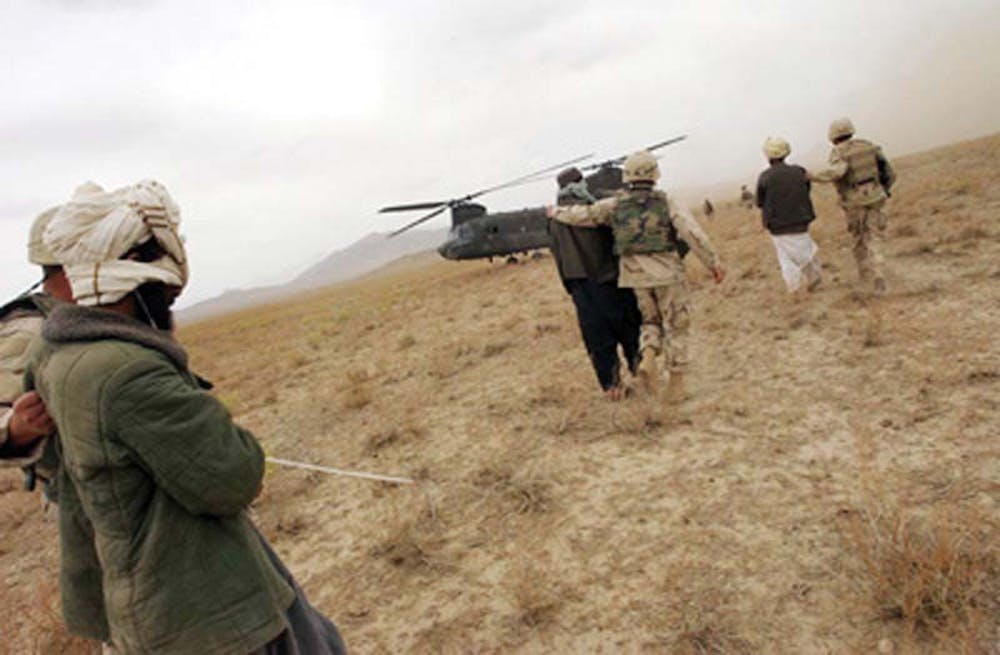
Gibney gives us an overview of the problem of detainee torture by following the story of a young Iraqi cab driver named Dilawar, who was fingered by a paid informant to have been involved in a rocket attack. He was sent to a Bagram prison where he underwent merciless abuse and interrogation until his death. Over the course of the film, we discover that Dilawar was innocent, and the informant paid off by the government was the real terrorist.
At the time of Gibney’s film, we had locked up 83,000 detainees since Sept. 11, none of whom have received legal hearings. “Taxi to the Dark Side” details the path of torture’s justification from the top down: The President has redefined “torture” and “habeus corpus” in allowing the government to subvert the legal rights of prisoners; American troops are trained to see any “suspected terrorist” as subhuman so that they are more apt to apply sleep and sensory deprivation, strip searches, 20-hour-long naked interrogations and physical beatings.
In retrospect, most of the troops recognize what they did was wrong, but at the time, they thought they were merely conforming to military protocol. Ironically, it was the low-level troops who were later charged with war crimes while President Bush, the man who directs all military action, managed to avoid blame for condoning the acts of torture.
Our country believes it is morally superior, yet popular opinion supports extreme physical torture for the purpose of gathering intelligence. In death, Dilawar has become a martyr and a symbol of American depravity.
Perhaps in torturing, America has constructed its own dark side.
America's 'Dark Side'
Get stories like this in your inbox
Subscribe