
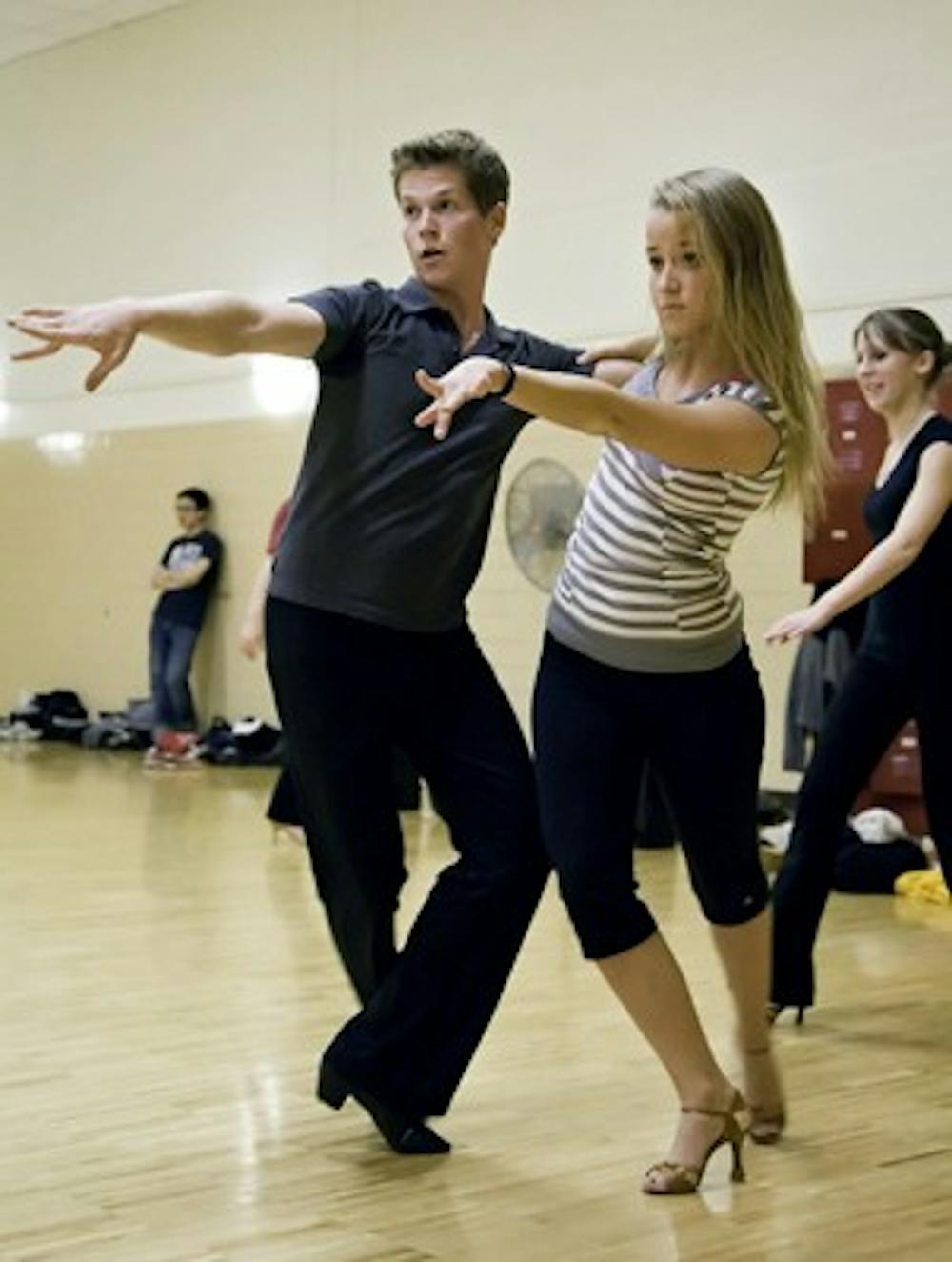
It’s a late Monday evening, but the members of the IU Dancesport team are ready to dance. Women buckle their pale satin heels as the men lace up their black leather shoes. Couples trickle onto the center of the dance floor of the stuffy gym. A noticeable shortage of men forces a few women to double up. \nIn between helping others refine their techniques, co-captain Andy Leister takes the center of the floor, dancing with an invisible partner – his expert form never faltering. \nThe IU Dancesport team, consisting of about 40 members, is the competitive extension of the IU Ballroom Dance Club. The team travels to competitions throughout the school year and is heading to Columbus, Ohio, this weekend for the National Collegiate DanceSport Championships. \nLike the majority of members on the ballroom dance team, Leister, a senior, started dancing less than two years ago. He was initially pressured into it by an ex-girlfriend, but it has since grown into a passion – a passion often met with negative criticism. But the men on the team say dance is just as athletic as any sport.\n“There’s a lot of stigma – and I don’t know any other way to say this – that dancing is gay somehow, in particular ballroom dancing,” Leister said. “But in my experience, it’s really not.” \nLeister said his friends have given him a hard time in the past, but once he shows them pictures of the women he dances with, the teasing abruptly subsides. \n“Women love men who can dance,” said Ballroom Club Council treasurer Philip Lincoln. \nIt appears Lincoln is right. A group of freshmen are watching with awe. Onlooker Mary Zwerneman sits on the sidelines with her friends. They came to watch the open practice and are considering joining. \n“I think it’s really cool when men dance because not many men do it,” Zwerneman said, never taking her eyes off the dancers’ quick, precise movements. She readily admits that she finds men who can dance romantic.\n‘Dancing is floorplay’\nLike Leister, junior Michael Sampson-Akpuru said he has confronted similar beliefs, especially regarding the femininity of dance. \n“I think what gives it that common misconception is the ability for a man to move his body like a woman. This kind of dancing requires you to be able to move your body flexibly and almost sensuously,” Sampson-Akpuru said. “That goes beyond what the average guy can do. And so because most of them cannot do it – just like if you don’t understand something, you ridicule it – that’s usually how it works.” \nActually, ballroom dances are structured to exaggerate heterosexuality, Lincoln said. Some dances, such as the tango, are clearly supposed to show flirtation with seductive eye contact and dominating movements, he said. \n“Certain body motions are meant to scream masculinity,” he said. “You’re taught to do that if you don’t do it already.” \nThe blatant sexuality of ballroom is no secret to the dancers. Many of them sport black team shirts that read “IU Dancesport” on the front and “dancing is floorplay” on the back. \n“We joke that (dancing) can be sex on hardwood,” said Council Marketing and Public Relations Chair sophomore Alex Kocher. “You have to walk on that dance floor, and you have to sell it – you have to sell sex.”\nAs a woman in ballroom dance, Kocher said she has found the men in ballroom are the “sweetest” guys. She also said some of the men she dances with have better bodies than her most athletic guy friends.
So you think you can dance?\nThere’s a reason competitive ballroom dancing is called Dancesport: It’s a serious workout. The dancers spend hours perfecting their moves, and as Nationals draw closer, practices are almost solely devoted to couples’ time. Though the team works together in preparing for competitions, each couple competes as its own team. IU Dancesport has ever-changing membership, and many couples have placed in the two competitions this semester.\n“In any sport, it’s gotta take concentration, focus and determination in order to win at what you’re doing,” Lincoln said. “You have to get instruction, work out and be in shape. (Ballroom) definitely increases physical abilities, balance, coordination and overall focus.” \nSampson-Akpuru played football and soccer in high school and admits that ballroom is very much a sport. \n“I must say, in comparison to the time commitment (of football and soccer), they’re about the same, but this requires a little more finesse,” he said. “For those sports you have to get it physically, but for this you have to be here mentally, psychologically and physically, so it takes a lot out of you.” \nAside from reaping the physical benefits of ballroom, a large part of its appeal is the timelessness of the sport. Many of the dancers on the team, male and female, are hoping to continue dancing socially after college. \n“The coolest thing about ballroom is you can get involved with it late in life and still do well in it,” Leister said. “It’s something you can either go off and bust your butt doing and be in really good shape, or go off and have fun with it. It’s a pretty flexible activity, I would say.” \nIU Dancesport and the Ballroom Dance Club are open to anyone who is interested, even those with no experience. The veterans work with the novices, and many of the dancers have taken the HPER E-109 social dance elective. The club encourages anyone with the desire to learn ballroom to join. \nThe number of male dancers that participate is inconsistent and the team is looking to stabilize that. Council President Steve Torres admits that while a girlfriend “dragged” him into ballroom, he’d always wanted to do it. \n“It’s kind of one of those secrets that guys have,” Torres, a sophomore, said. “They’re just kind of like, ‘I wish I could dance, but I don’t wanna take lessons because it’s not manly.’”



