
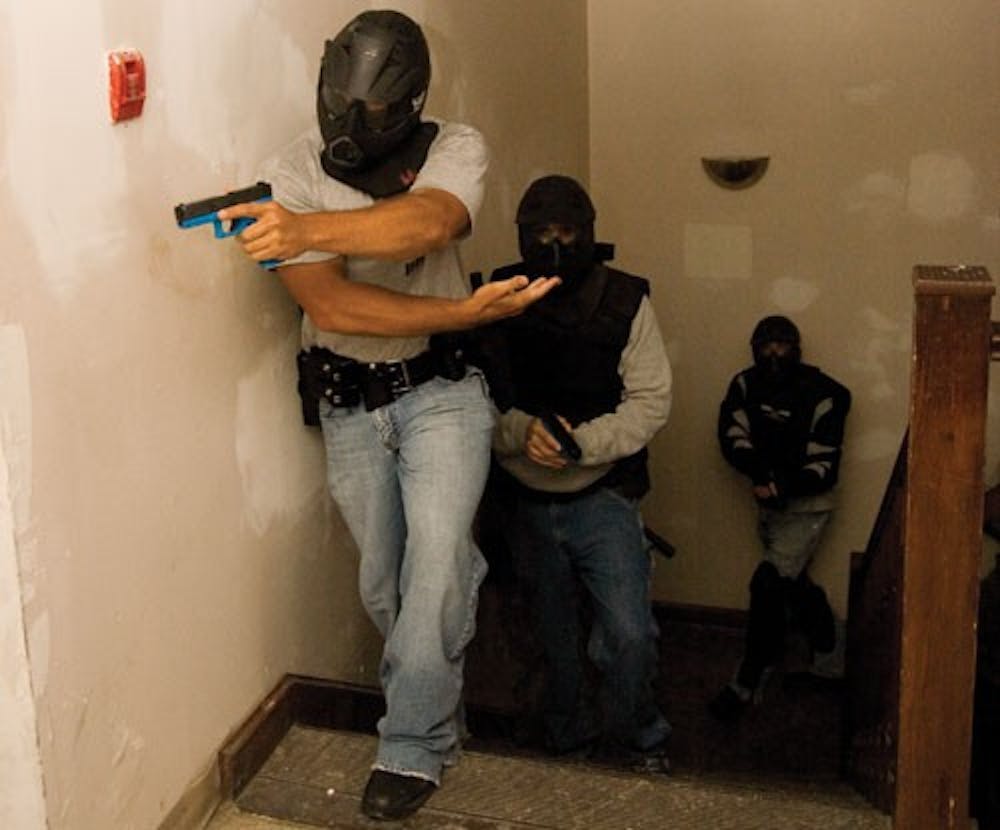
As IU Police Department cadets cautiously walked up the stairs of the old Phi Kappa Alpha fraternity house, guns drawn, Sgt. Mick Williams yelled, “Scenario in play!”\nThe phrase echoed throughout each room as cadets relayed the message to other cadets. The scenarios were part of IUPD’s active shooter training held last Friday, during which cadets practiced with paintball guns the techniques they would use if someone began shooting in a building or other public area. \nWilliams, who is with the Bloomington Police Department, has experience with SWAT teams and organized Bloomington Police Department’s Basic SWAT School.\nThe training session began outside the front of the building, where Indianapolis Metropolitan Police Department officer Josh Barker demonstrated how to use a taser and a pepperball gun. A taser momentarily causes motor dysfunction in the area it’s applied, while a pepperball gun shoots multipurpose grenades. The grenades look like simple paintballs, but are filled with CS agent, commonly known as “tear gas,” which is used most often for crowd control. \nThe IUPD Police Academy, which has been in place since 1972, is the only college police academy in the country. Lt. Greg Butler said the academy began its active shooter training after the 1999 shooting at Columbine High School. \n“We saw changes that had to be done – it used to be that you called the SWAT team in,” he said, adding that the shootings in April at Virginia Tech further heightened the need for special training. \nA few students volunteered to help demonstrate the tools, and some yelled in discomfort after being tased or shot in the back with pepperballs. Cadets watching the display exclaimed in sympathetic pain as junior Sofia Halvacs showed her circular red welts on her back from where she had been hit. Halvacs said she didn’t know what to expect when she volunteered. \n“I didn’t know really what it was,” she said. “It feels like someone’s hit you with a baseball bat.” \nAs it began to rain outside, the group moved inside to practice finding and detaining gunmen. Various Bloomington and IUPD officers volunteered their time to portray active shooters as well as innocent bystanders in order to make each scenario as real as possible for the cadets. \nAt the start of each session, Williams walked up a winding staircase behind four cadets, who were told to choose the formation they thought would be most effective – the cadets could arrange themselves in the shape of a Y, diamond or line. After the scenario ended, Williams explained to the cadets what they did wrong and why the scenario had been set up the way it was.\nIndianapolis Metropolitan Police Department officer and former IUPD officer Michael Antonelli spoke to the cadets in class before they went to training. Antonelli lost his right eye when he was shot during what started as a routine traffic stop in 2005. Senior Nick Lewis said Antonelli’s story put the training in perspective for him.\n“To actually hear someone’s story makes it more real,” he said. \nButler said while police officers are trained with different techniques to deal with shooters, there are things the public can do if an active shooter situation arises. Butler said people should get out of the area if at all possible, and if not, fight. He illustrated his point with the example of Sept. 11, during which passengers on the hijacked planes stood up to defend themselves.\n“Don’t be a willing victim; go down fighting,” he said. “You can’t stand by and do nothing.” \nButler said the simulation not only helps cadets make decisions about how to approach each situation, but it also provides a way to see which cadets are fit to be officers. \n“This is how we gauge a person’s mentality to do this,” he said. “If they can’t, they’re not going to be a police officer.”
Shooter training prepares IUPD cadets
Phi Kappa Alpha fraternity served as training facility
Get stories like this in your inbox
Subscribe



