
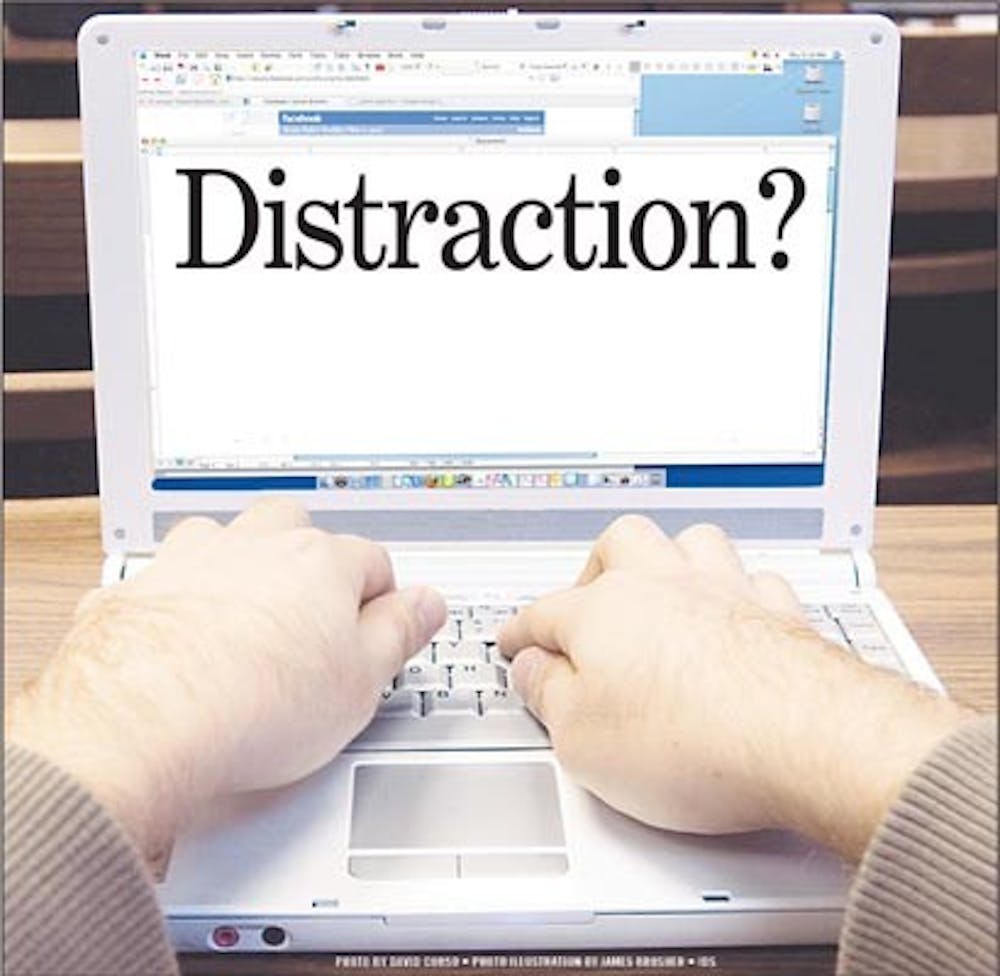
Few can argue against technology improving education. But some professors worry its expanded use is starting to have a negative impact in the classroom.\nMany students enjoy the advantages of using a laptop in the classroom, but some admit it offers them the opportunity to get off-track in class.\n“I’m a slacker sometimes and space off in class,” senior Kyle Telechan said. “I use (my laptop) to network with my friends in class.”\nBut many students who use laptops in class – even those like Telechan who say they “space off” – claim it makes the learning experience much simpler.\n“If the professor says something I don’t understand, I will go on Wikipedia and look up whatever I didn’t understand,” Telechan said. “If I miss class notes I can also e-mail my friends (who use laptops to take notes) and get the notes a lot easier than (copying) paper notes.”\nIn an unscientific survey of 202 IU faculty and staff members conducted by the Indiana Daily Student, almost all said laptops can distract from class lessons, and many have personally witnessed distracted students. But most of the surveyed faculty and staff members said they believe some students are using laptops for classroom purposes.\n“I am sure that (laptops) are being used for other purposes rather than class by some students,” instructor Jeanie Alter said in an e-mail. “However, there are others that take notes and look up topics relevant to class.\n“I have even asked students to look up an answer to a question for me. It was just another way to keep them engaged and taking responsibility for their learning.”
The cost of distraction\nStudents’ classroom distraction is a problem, but many professors said they feel little sympathy for those who fall behind because of poor study habits. Students, after all, are responsible for their own learning experiences.\n“I don’t check on what they may be doing with their laptops or minds,” Henry Prange, a professor in the Medical Sciences Program, said in an e-mail. “I also let them sleep if they wish. They can use the time they bought with their tuition as they see fit.”\nStill, 11 percent of the instructors surveyed said they have a policy banning the use of laptops in class.\n“It’s unfortunate to penalize those who are using their computers appropriately,” Eric Sandweiss, a professor in the Department of History, said in an e-mail, “but banning laptops from class is the only way I know to ensure that students aren’t being distracted by e-mail, chat, games and online reading while they’re supposed to be focused on a lecture.”\nMost professors continue to allow laptops, claiming the problem is students’ lack of focus, not the computers. Some have changed their teaching styles so students are less likely to become distracted.\n“(Students) clearly do other things in class (than) listen to me,” Daniel Conway, a visiting clinical associate professor in the Kelley School of Business, said in an e-mail. “One has to change the way they teach to make the material consume (the students) and their attention, and have a deliverable due at the end of class.”
Classroom spies\nConway said he has staged his own experiments to determine how laptops are used in his classroom. He has embedded student “spies” in the back of his classroom and has found that only about 20 percent of students stay on topic throughout a class period.\nStill, most professors claim they see a great advantage for students and the learning process by allowing the use of laptops in class. In the survey, many instructors said students can take notes more quickly by typing than by writing in a notebook.\nAnd students can be distracted in class just as easily without a laptop.\n“I’m sure that the students who use the laptop for other things – if all they had was the same notebook – would simply have doodled or looked out the window,” instructor Matthew Guterl said in an e-mail. “If they want to learn something in the class, they have to pay attention. And if they don’t, it will show in their work for the class, and they’ll do poorly.”\nMost instructors said they feel students have a responsibility for their own educations. Laptops or no laptops, students have to find a way to learn the material.\n“I used to account for some students’ inability to focus on their academic work in terms of this very complicated theory about technology, the condition of post-modernity and the rise of multitasking as a mode of psychic crisis management in an age of information overload,” Colin Johnson, an assistant professor of gender studies, said in an e-mail.\n“Then I decided I was over-intellectualizing the problem,” he said. “Now I just think that the handful of students who inevitably sit in every lecture and watch clips from ‘Jackass’ on YouTube are rude, immature and intellectually mediocre.”



